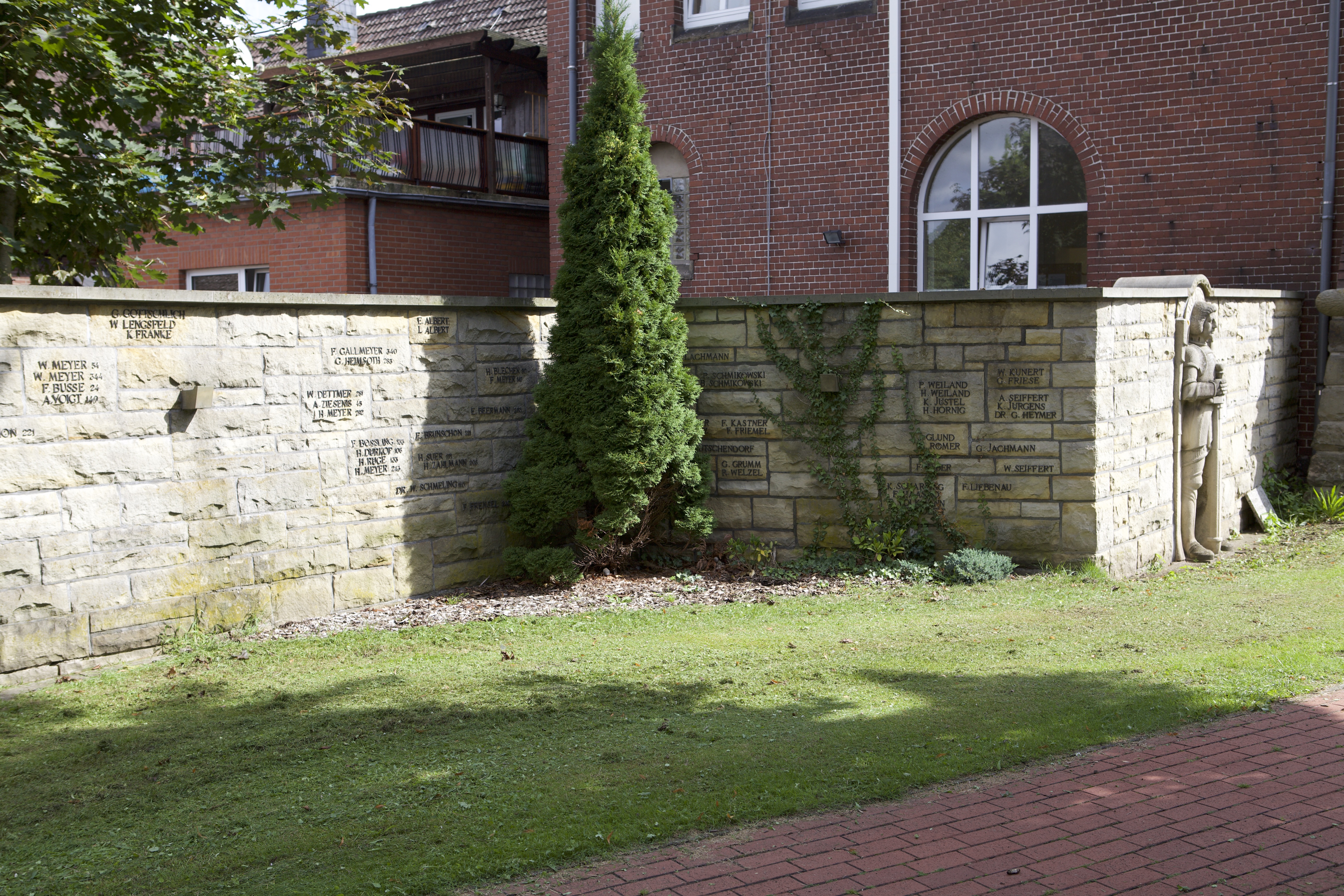
Bad Rehburg

Bad Rehburg
Grabsteine mit den Namen der verstorbenen polnischen Zwangsarbeiter und Insassen verschiedener Lager

In the burial plot of World War II victims there are 24 tombstones that - apart from Polish names - bear the names of Russians, Yugoslavs, Lithuanians, Belgians, Romanians and 1 Dutch, but also Germans from the First World War. Most of the deceased from the post-war period were forced labourers and prisoners of surrounding gulags as well as 26 children and five former prisoners of war. The deceased were mainly patients of the Montgomery Red Cross hospital established by the British after the war, which treated liberated prisoners of concentration camps, prisoners of war and former forced labourers who required intense medical care after years of imprisonment for tuberculosis and exhaustion. Many received medical assistance too late.

One of the deceased was second lieutenant Witold Kazimierz Klippel a.k.a. "Kopczewski", a soldier of the Home Army and participant of the Warsaw Uprising (plot No. 7, row 4, tomb No. 49).

The cemetery is located in a park, near the B 441 road leading out of the town towards Wunstorf. The plot is neat and taken care of by the municipal greenery and cemetery administration authority.

Mediathek Sorted

Media library
  • 1: Gravestones for former Polish and Russian forced labourers and prisoners from various concentration camps

    Most died as a result of serious illnesses after the end of the war in 1945 and 1949. Bad Rehburg, undated
  • Gravestone for Polish people who died in 1946

    Detailed view of the middle gravestone from image 1 above. Bad Rehburg, undated
  • 3: Gravestone for Polish people who died in 1945 and 1946

    Close-up of the right-hand gravestone in image 1. Bad Rehburg, undated
  • 4: Gravestone for Polish people who died in 1945

    A child died in 1947. Bad Rehburg, no date
  • 5: Three gravestones for Polish women and men who died in 1946

    The following images are three detailed photographs. Bad Rehburg, undated
  • 6: Gravestone for Polish forced labourers and inmates of various camps who died in 1946

    The left-hand gravestone of the three in image 5. Bad Rehburg, undated.
  • 7: Gravestone for Polish forced labourers and inmates of various camps who died in 1946

    The middle of the three gravestones in image 5. Bad Rehburg, undated.
  • 8: Gravestone for Polish forced labourers and inmates of various camps who died in 1946

    The right-hand gravestone of the three in image 5. Bad Rehburg, undated.
  • 9: Four gravestones for former forced labourers who died in 1947

    The gravestone on the right is for Yugoslavian people, the others are for Polish people. Bad Rehburg, undated
  • 10: Detailed view of the leftmost of the four gravestones in image 9

    Bad Rehburg, undated
  • 11: Tombstone for Russian forced labourers and inmates of various camps

    Died in 1948 and 1949. Bad Rehburg, undated
  • 12: Two gravestones for Russians (left) and Yugoslavs (right) who died in 1949.

    Former forced labourers and inmates of various camps. Bad Rehburg, undated
  • 13: Detailed view of the left gravestone from image 12

    Bad Rehburg, undated
  • 14: Memorial stele for those who died in the world wars

    Framed by conifers. View from behind, Bad Rehburg, undated.
  • 15: The stele and gravestones for the former forced labourers and inmates of various camps

    Bad Rehburg, undated
  • 16: Front view of the stele for the dead of the world wars

    Bad Rehburg, undated
  • List of names of Poles buried in the cemetery in Bad Rehburg

    Former forced labourers and inmates of various camps, deceased between 1945 and 1949 as a result of inhumane treatment during the Nazi era. In Polish, undated.